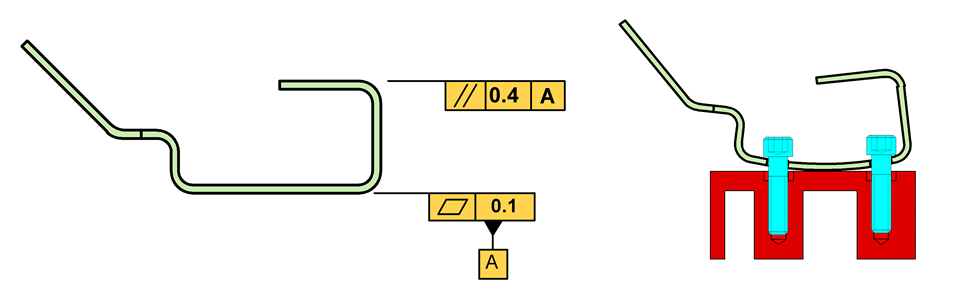
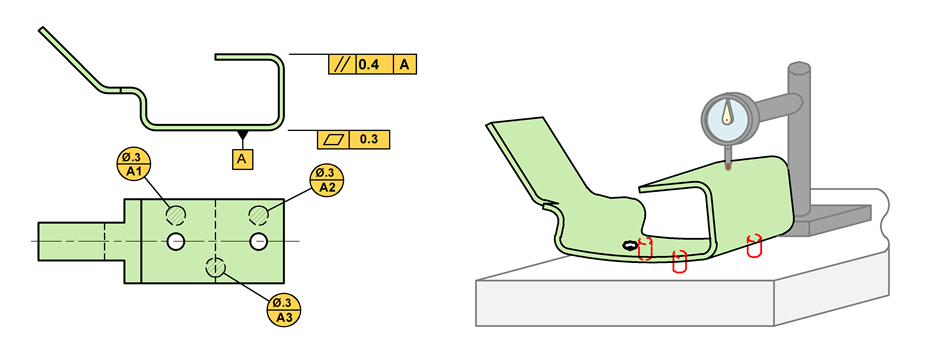
When a flat surface is used as a primary datum feature, three considerations should be made to assure reproducible measurement and a functional part.
1. Consider a flatness control on the datum feature. The primary datum is often a mounting surface that may be clamped during assembly. Clamping may cause strain in the part. Strain causes stress and other critical features to vary in position or orientation. The flatter the datum feature, the less distortion of the part.
2. If the part is prone to distort and a tight flatness control is impractical, consider a constraint note. A constraint note is usually intended to describe the condition of the part after assembly.
3. If a tight flatness control or constraint note does not fit your situation, datum targets should probably be specified. Since three points determine a plane, three targets should be used on a primary datum feature that is establishing a plane. If four or more targets are used, it is advisable to also include a constraint note.
Note: the 1994 standard, [4.3.3], only says “Consideration shall be given” to controlling datum features, but both 2009 [4.9] & 2018 [7.9] explicitly require that datum features are controlled by geometric controls or size tolerances. In the case of a primary plane, a flatness tolerance should always be used, even if it needs to be a loose tolerance, due to distortion or surface irregularities.
This tip is in accordance with ASME Y14.5M-1994, ASME Y14.5-2009 and ASME Y14.5-2018. This tip was originally released in April 1998.